A solo founder built one of the fastest-growing GitHub projects ever in under three months and was quickly acquired by OpenAI.
No team. No VC. Negligible burn. Massive distribution.
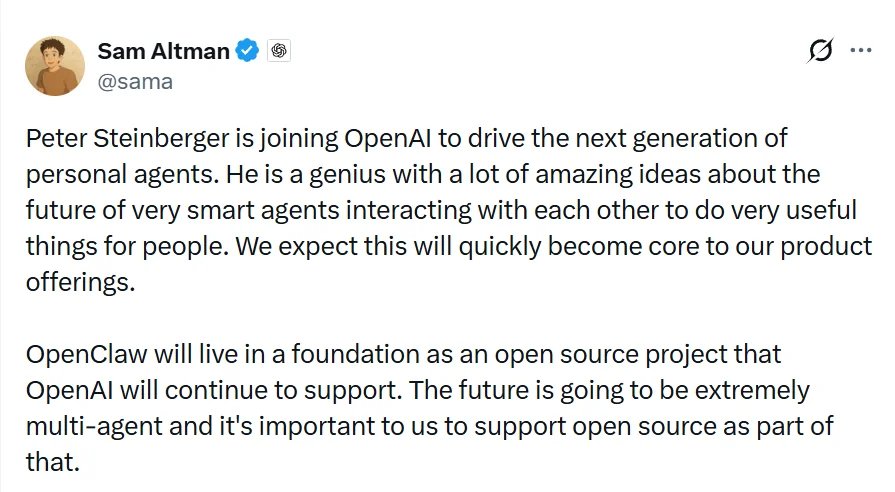
While the headline is catchy, the structure underneath is more interesting.
The Stack Has Split
AI has clearly separated into two layers:
Model layer — Capital intensive. Multi-billion dollar training runs. Concentrated ownership.
Agent / application layer — Orchestration, workflow design, UX, integration. Fast, capital light, API-driven.
OpenClaw did not train a model — it composed one. When frontier intelligence is accessible via API, the constraint shifts from infrastructure to judgment and speed.
Leverage Has Changed
Historically the startup function was:
more output → more people (capital × labor)
Now:
more output → more compute calls (talent × compute × agents)
A single founder can:
- Access frontier models
- Run parallel agent workflows
- Ship continuously
- Distribute globally
Compute handles the parallelization of cognitive labor. Organizational size no longer scales linearly with productive output. That is new.
Productivity Without Immediate GDP Reflection
This kind of leverage increases real productive capacity yet it may not immediately appear in GDP statistics.
GDP tracks recorded labor income and monetized output. When one founder, augmented by agents, produces what previously required ten engineers:
- Headcount decreases
- Payroll contracts
- Organizational size shrinks
Measured labor input falls while actual output per capita rises. The system becomes more efficient before the accounting identity adjusts.
AI compresses the labor component of production first. Monetization scales afterward. Productivity increases at the individual level but macroeconomic statistics will only adjust later.
The Structural Shift
Compute per capita is not abstract. When one person can access frontier-scale intelligence and deploy it globally, productive capacity detaches from organizational size.
That is a structural shift.
The one-person company is not an anomaly. It is a direct consequence of abundant, cheap compute.
As compute per capita increases, these outcomes become less exceptional and more systemic.
This is not about smaller teams. It is about compute becoming the dominant multiplier of human capability.