If 2011–2021 was the software decade, 2026–2036 will be the hardware decade.
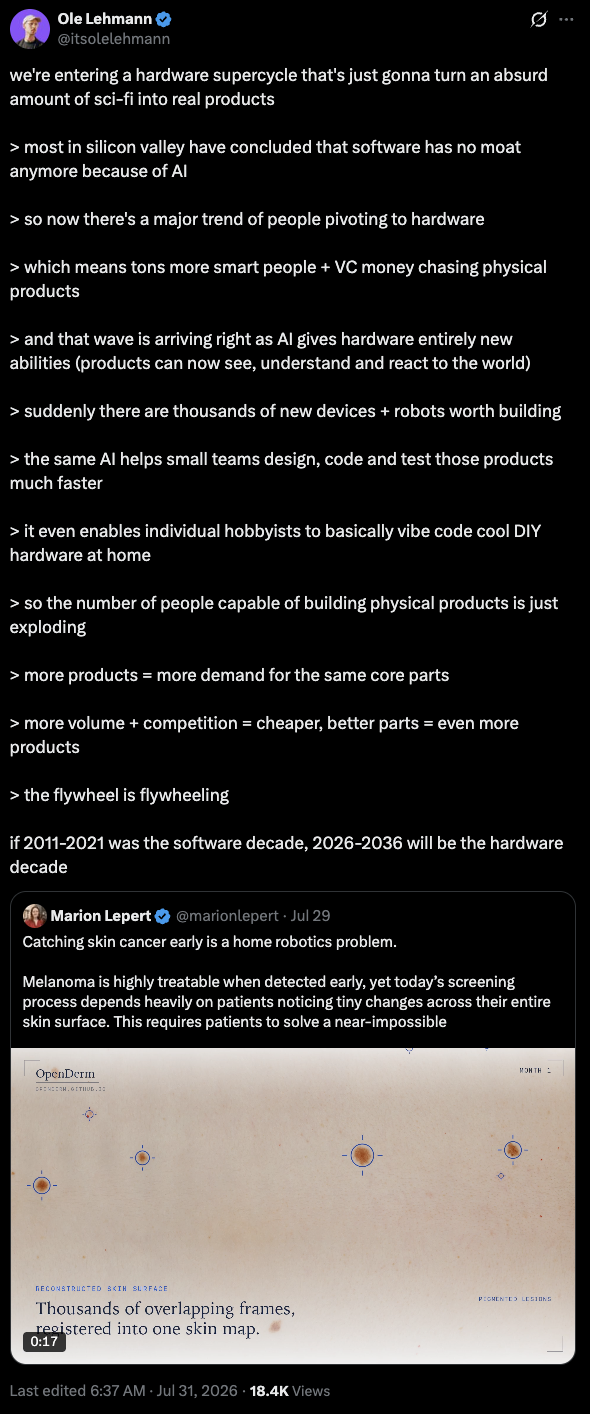
Three forces are converging at the same time, and each one amplifies the others.
Software Moats Are Collapsing
Much of Silicon Valley has reached the same conclusion: AI has compressed the cost of writing software so far that pure-software moats are evaporating. Any feature can be replicated in weeks. Distribution and brand still matter — code itself is no longer a defensible asset.
Capital follows incentives. Deep tech now accounts for roughly a third of global venture funding. One in four unicorns minted in 2026 came from robotics, defense, and aerospace alone — up from one in five just two years ago. Deep tech companies raised $177 billion in 2025, an 82% jump year over year.
The rotation isn't coming. It's here.
Hardware Just Got New Abilities
The rotation is arriving exactly as AI gives physical products capabilities they never had. Devices can now see, understand, and react to the world. Perception was the bottleneck for robotics for fifty years — that bottleneck is gone.
Suddenly there are thousands of devices worth building that weren't viable three years ago. Home robots that screen skin for melanoma. Autonomous inspection systems. Machines that adapt instead of executing fixed routines.
The Same AI Compresses Hardware Development
The third force closes the loop: the AI that makes hardware smarter also makes it faster to build. Small teams design, simulate, code, and test physical products at a pace that used to require entire engineering departments. Hobbyists prototype at home what once needed a lab.
The number of people capable of building physical products is exploding.
We've Seen This Flywheel Before
Chris Anderson called the drone boom "the peace dividend of the smartphone wars" — sensors, GPS, cameras, ARM processors, and batteries developed at smartphone scale became available for a few dollars, and entire industries were born downstream. Components that were military-industrial unobtainium ended up at RadioShack.
The same dynamic is starting again, at larger scale:
More builders → more products → more demand for the same core components → more volume and competition → cheaper, better parts → even more products viable.
Except this time the dividend flows both ways. Smartphones only gave hardware cheap parts. AI gives hardware cheap parts, new perception, and compressed development cycles — simultaneously.
Where This Compounds
Every layer of the cycle is physics-constrained. The robots need compute. The compute needs energy. The whole stack needs manufacturing that scales.
The hardware decade isn't a rotation away from software — it's software finally reaching the physical world, with energy and compute as the binding constraints.