Recently, leading theoretical physicists reported that a frontier model from OpenAI assisted in deriving and formally verifying a new result in quantum field theory.
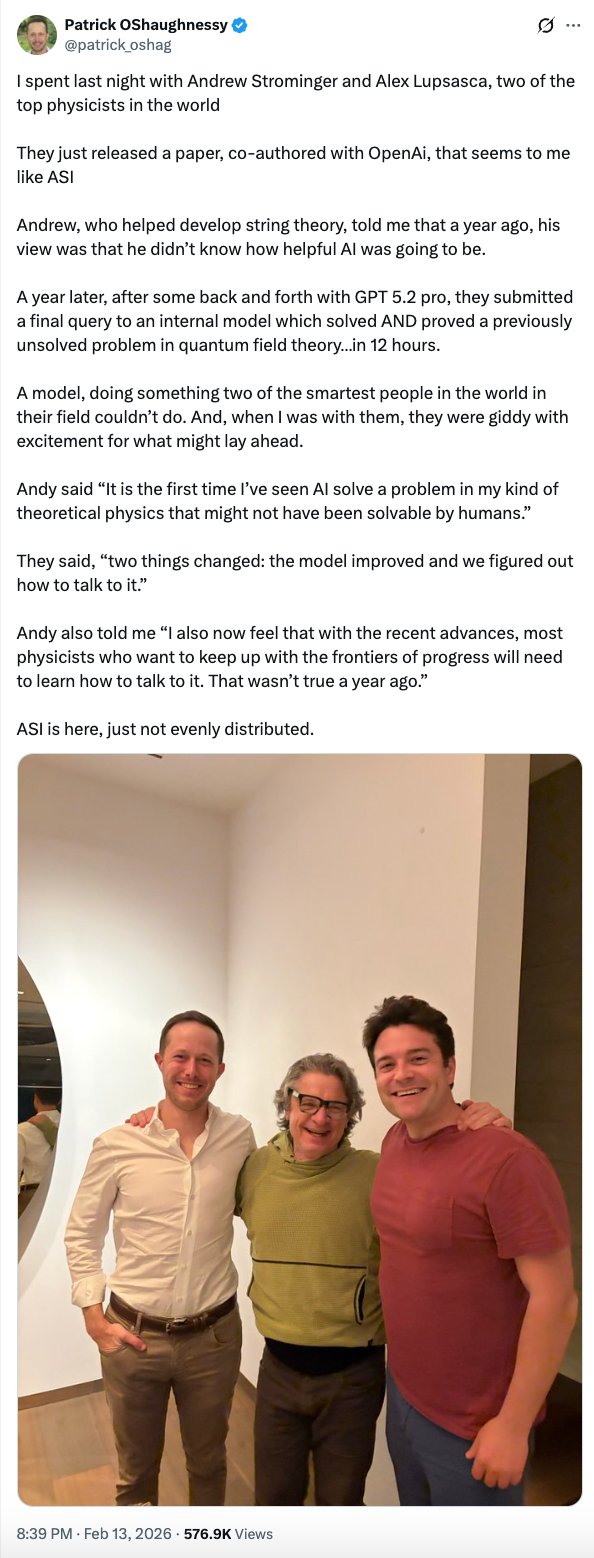
This is not about faster computation. It's about participation in proof.
Historically, major technological waves followed advances in theoretical physics:
| Physics Breakthrough | Technology Enabled |
|---|---|
| Maxwell's Equations | Electromagnetism → telecom, power grids |
| Thermodynamics | Heat engines → industrialization |
| Relativity | Nuclear energy, GPS |
| Quantum Mechanics | Transistors, semiconductors, lasers |
| Nuclear & Particle Physics | MRI, PET, the Web |
| Statistical Mechanics | Foundations of modern AI |
The pattern is stable: Abstract theory → new physical constraints → new engineering primitives → new industries.
The bottleneck has always been theoretical insight.
What Actually Happened
The recent result involved gluon scattering amplitudes — core objects in quantum field theory that describe how fundamental particles interact.
These amplitudes are notoriously complex. Their structure encodes deep symmetries of nature. Deriving general expressions often requires years of symbolic manipulation and pattern recognition across special cases.
In this instance, the model:
- Identified simplifying structure across computed cases
- Proposed a general expression
- Contributed to a formally verified proof
The key is formal verification. This was not heuristic pattern matching. It was mathematically validated.
Why This Matters
Many frontier technologies are theory-gated:
- Room-temperature superconductivity
- Scalable quantum computing architectures
- Advanced photonic and topological materials
- High-efficiency energy systems
Engineering cannot outrun physics. If AI compresses the time required to derive and verify new theoretical results, the rate of new technological primitives increases.
Thomas Kuhn described scientific progress as punctuated by shifts in how knowledge is produced. If AI becomes a reliable collaborator in formal theoretical discovery, that qualifies.
This does not replace physicists. It scales their effective search space.
If this capability generalizes across condensed matter, quantum information, and materials physics, we may be at the front edge of a wave of unlocks — not incremental product upgrades, but new physical regimes becoming engineerable.
That's upstream leverage at the level that actually compounds.